Cardiac apprehension does not really feel abstract when it occurs in front of you. It looks like a coworker dropping over a workdesk, or a grandparent going peaceful during supper, or an unfamiliar person at the fitness center who suddenly stops relocating. In those minutes, aid gets here in minutes if you ask for it, yet a mind can endure irreversible damages in four to 6 minutes without oxygen. The interval between collapse and the first chest compression is where average people make the difference. That is the heart of community safety, and it is why CPR training belongs in the same group as learning to drive or swim.
I have actually instructed first aid and CPR for years to teachers, tradies, parents, protection team, and senior high school students. The pattern corresponds. Individuals show up believing CPR training is a box to tick, after that leave comprehending it as a life skill that re-shapes how they discover danger, exactly how they choose under pressure, and just how they turn up for others. The benefits run much deeper than follow this link a certificate for your wallet. They change a neighbourhood's odds.
What CPR Really Does, and Why Seconds Trump Everything
CPR, or cardiopulmonary resuscitation, is not concerning "reactivating the heart" with your hands. It is a way to keep blood relocating to the mind and essential organs when the heart has quit pumping successfully, typically due to an unexpected cardiac arrest. Good breast compressions produce a portion of typical blood flow, yet that portion is enough to buy time until a defibrillator can correct a shockable rhythm or sophisticated care can take over.
The math that underpins necessity is basic and grim. For every single minute without CPR, the opportunity of survival from cardiac arrest drops by about 7 to 10 percent. If a bystander starts CPR within the initial minute or more, survival rates can double or perhaps three-way compared to situations with no early activity. These allow swings driven by tiny choices: progression, call for aid, begin compressions, ask somebody to bring the AED.
I have viewed family members freeze while a young adult from a lifeguard class took cost and led effective compressions. Training does not make you brave. It provides you a manuscript your body can comply with when your mind is buzzing.
The Real-World Forming of a Bystander Rescue
If you have not taken a cpr course, it is easy to think of disorder. In practice, a well-taught cpr training class breaks the moment right into a sequence you can hold.
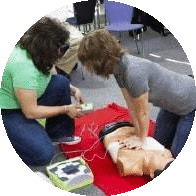
You look for responsiveness. You scream for aid. You call emergency situation services on audio speaker so the operator can coach and capture the address while you stick with the individual. If there is no typical breathing, you start chest compressions at a depth of regarding five to six centimeters for a grown-up, at a rhythm close to the beat of "Stayin' Alive." If an AED shows up, you turn it on, put the pads as illustrated, and comply with the triggers. The device examines the rhythm and tells you whether to press the shock switch. You resume compressions instantly after.
I have seen this adjusted on the fly in a child care setting with a kid, and in a carpark with a guy twice my size. Strategy varies with age and physique, however the foundation of action stays: push hard, press quick, allow full upper body recoil, lessen stops, and utilize the AED swiftly.
The Ripple Effects of Training Beyond Cardiac Arrest
When people register in a first aid course, they frequently anticipate plasters and recovery positions. They leave with a broader lens. First aid and cpr training boosts danger recognition, communication abilities, and group coordination. You come to be the person that notices the choking threat at a barbecue and cuts grapes lengthwise for young children. You discover to check for a departure path at crowded places, not from paranoia yet from habit.
In offices, this way of thinking minimizes not simply the intensity of events, but their regularity. A stockroom that trains and revitalizes its first aiders generally tightens its housekeeping, identifies its chemical shops plainly, and places automated outside defibrillators where they can be found without a scavenger quest. People take breaks when they should. They report near misses out on. Security becomes social, not performative.
Training also cleans up myths. I still fulfill grownups that believe you need to place something in the mouth of an individual having a seizure. You need to not. Or that you can "feel" a pale pulse under stress. Numerous can not. Standard first aid and cpr courses correct these practices delicately, and replace them with trusted skills you can apply under pressure.
A Short Story From a Supermarket Aisle
Several years ago, a colleague of mine was shopping when a guy collapsed near the produce area. He explained the check out line going silent, after that the spread noise of individuals shouting for water, which never ever assists. He actioned in, identified himself as first aid educated, checked for breathing, and started compressions on a glossy tile floor.
A shop worker got here with an AED from the wall surface beside the team area. It was dirty, which informed us nobody had actually touched it in months. Still, it powered on. The device recommended a shock. They cleared and pushed the button, after that went back to compressions. The ambulance arrived after the second shock. The guy lived.
What kept that man active was not luck. It was the junction of three average decisions: the supermarket had mounted an AED, my colleague had taken a cpr course the previous springtime, and an onlooker had the clearheadedness to call emergency situation solutions loudly and plainly. Area security is built out of these little, monotonous investments.
What a Good CPR Course Really Teaches
There is a distinction between reading a poster and practicing on a manikin up until your arms shake. Evidence-based training threads the line in between realism and safety. A reliable cpr course must include the following:
- Hands-on compressions with comments on deepness and rate, ideally utilizing manikins that measure efficiency and provide online cues. AED usage from beginning to end, consisting of pad positioning on grownups and children, voice triggers, shock distribution, and secure resumption of compressions. Airway skills proper to the degree of training, from head-tilt chin-lift to pocket mask use, and assistance on when to add rescue breaths. Scenarios that develop decision-making: solitary rescuer in a limited space, teamwork across a loud environment, treatment of a casualty with suspected spinal injury. Safety, hygiene, and permission, consisting of just how to secure on your own from biohazards and just how to appreciate social borders while giving lifesaving care.
Those five elements permit people to progression without improvisating strategy on the most awful day of someone's life. They likewise produce a typical language, so you and an unfamiliar person can work with without friction.
Where First Aid and CPR Fit Together
Pure cpr training is focused and fast, which matches groups that need a narrow skill set. Several organizations, nevertheless, select a wider first aid and cpr course that covers more ground in a solitary session. The hybrid approach makes sense for colleges, health clubs, community centers, and building websites. You cover CPR and AED usage, but also bleeding control, burns, choking, first aid course Mandurah allergies, diabetic person emergencies, bronchial asthma action strategies, and workplace-specific risks.
The added time pays off in circumstances that are not right away harmful yet can degrade if ignored. I think about the pupil who acknowledged anaphylaxis at smoko since he had found out the early indications, provided an auto-injector, and monitored breathing while waiting for paramedics. That result hinges on first aid training that expands past compressions.
If you are balancing time and budget plan, pair a much shorter cpr course with available microlearning refreshers, or choose a complete first aid and cpr course every 2 or 3 years with scheduled technique in between. Specifications can vary by nation and market, so examine regional assistance when choosing what mix of training your team needs.
The Case for Refreshers: Skills Fade, Confidence Faster
Skill decay in CPR is not a personality imperfection. It is biology and memory. Research studies reveal measurable decrease in compression top quality and AED sequence recall within months after training, particularly if you have actually not used the skills. Self-confidence commonly declines also quicker than first aid training Mandurah proficiency, which means people think twice much longer, or defer to others.
That is why a cpr correspondence course is not a deluxe for nit-pickers. It is a maintenance routine for abilities you hope you never require. Short, concentrated refreshers can be as quick as 90 mins and provide an out of proportion advantage. You rectify your compression depth, you rehearse pad positioning, you keep in mind to change compressors every 2 mins to avoid exhaustion, and you adapt to any changes in guidelines.
I have watched entire teams enhance in a single afternoon since they practiced with metronome applications, turned roles deliberately, and connected the training to their real floor plan. Refresher courses turn understanding right into muscle mass memory.
Why the Certificate Matters, and Why It Does Not
A first aid certificate does 2 points. It signals to companies and regulators that you have satisfied a standard, which can be crucial for insurance policy and conformity. It additionally offers you a timestamp, a pointer that abilities age and will need an additional look.
What it does refrain from doing is make you unsusceptible to adrenaline. Even with a new certification, your hands might tremble during a real occasion. That is typical. The step that counts is not perfect implementation, however timely, reliable action. An excellent carrier creates courses that accept human limitations and construct redundancy. You may start compressions a little off center, after that self-correct after the very first cycle. You might fumble an AED pad, then recoup. The person on the ground does not require excellence. They require oxygen moving.
Choosing an Educating Provider Without Regret
The training market is crowded, and top quality arrays extensively. You want a service provider that premises their first aid courses in current standards, invests in appropriate tools, and shows in ways that recognize real-life constraints. If a training course dedicates the majority of the day to move decks and sends out 20 students to a solitary manikin, that is a red flag.
Ask concerning fitness instructor experience, not simply credentials. Teachers that have actually operated in field setups, whether as paramedics, nurses, lifeguards, or occasion medics, have a tendency to surface edge instances that make the web content stick. They can discuss, for example, just how to perform compressions on a soft mattress making use of a backboard, or exactly how to handle privacy and authorization in a jampacked office. A supplier like First Aid Pro, or any respectable regional company with a solid record, ought to have the ability to detail how they update training courses when global resuscitation councils revise their guidelines.
Finally, look for alternatives that suit your people. Evening courses for hospitality staff. Onsite training for construction crews. Combined discovering where concept is on-line and the useful is face to face. The most effective training course is the one your team finishes with interest and preserves with pride.

The Psychology of Tipping Forward
Most bystanders do not act since they fear doing harm or being condemned. These fears are understandable, but they do not mirror what we understand. In many territories, Do-gooder protections exist for people that make help in excellent faith. Much more significantly, the risk of inactiveness outweighs the danger of incomplete action in cardiac arrest. Upper body compressions on a person whose heart is beating are awkward but seldom dangerous. Doing nothing while the brain deprives is catastrophic.
Training shifts psychology by providing individuals a psychological map. In class, you exercise stating, "You, in heaven shirt, phone call three-way no and restore an AED," also if there is no blue t shirt. That practiced assertiveness matters. I as soon as showed a team of educators that groaned at the role-playing, after that two months later on used precisely that wording to collaborate a reaction to a choking occurrence in the lunchroom. Method does not just sharpen your hands. It lends your voice authority.
Technology Aids, People Save
AEDs are smarter, lighter, and much easier to use than they were a decade earlier. Some have actually pediatric settings constructed right into the same unit. Many give metronome cues for compression rhythm and trainer you with the process with clear voice motivates. Smart device assimilation can crowdsource neighboring -responders in some cities, signaling qualified volunteers when there is a suspected cardiac arrest within a few blocks.
Even with far better gear, the human element stays crucial. An AED in a locked workplace may also get on the moon. A volunteer network is just as solid as the people who maintain their cpr skills fresh. Owners should check AED battery and pad expiry dates, blog post clear signage, and run brief drills so that employees can recover and release the gadget without hunting for keys or presuming a code. Technology reduces the course to a shock, however just if individuals maintain the path clear.
Special Contexts: Children, Professional Athletes, and Country Settings
CPR on infants and kids calls for adjustments. You make use of one or two hands for a little kid, two fingers for an infant, and you transform your compression depth and rate as necessary. Most first aid and cpr courses include these variants since moms and dads, teachers, and coaches request for them. The risks feel higher with kids, and the concern of doing damage can freeze individuals. Educating carves that are afraid to dimension with repetition.
Athletic atmospheres position a different dynamic. Abrupt heart attack in sport is rare, however when it happens, it occurs in public with dozens of sightseers. Groups that run preseason cpr training for training personnel, situate AEDs at fields, and develop an easy emergency situation strategy cut crucial minutes. I have actually seen clubs turn a chaotic scene right into a collaborated initiative due to the fact that they put an AED case outside of a clubhouse and strolled young adults with just how to make use of it.
Rural and remote neighborhoods deal with the lengthiest rescue feedback times. That space makes regional capacity a lot more useful. A community hall with an AED, a couple of residents who have actually completed a cpr course, and a phone tree for emergencies can alter end results dramatically. In those settings, first aid training usually includes improvisation: using products handy for padding, taking care of hypothermia in wintertime rescue situations, or passing on directions to -responders over irregular mobile service.
How to Develop a Society, Not a Checkbox
If you want CPR proficiency to stick, connect it to identification. A cafe that celebrates its baristas for completing cpr training and blog posts a tiny indicator near the till will prompt discussions and remind personnel they belong to a safeguard. A school that weaves first aid right into health and wellness education, after that does short refreshers for instructors each term, constructs continuity. A building and construction firm that consists of a cpr correspondence course in its seasonal start-up conferences makes it clear these skills matter as long as difficult hats.
It additionally helps to lower friction. Pre-schedule programs and refresher courses. Offer choices in language and timing. Offer light snacks. Put AED locations on workplace maps. Keep first aid sets stocked and visible, and select a person to have that task. These are tiny operational choices that transform intent into habit.
The Peaceful Benefit: Confidence and Neighborhood Cohesion
The most regular responses I hear after a first aid and cpr course is relief. Not bravado, not swagger, just the peaceful understanding that if something happens, you are not helpless. That feeling surges via houses and groups. Moms and dads rest a little less complicated with a brand-new child in your home. Managers fret less when a personnel returns from cardiac surgical treatment. Teammates on a Saturday league area care for each other with even more care.

It also transforms just how we treat unfamiliar people. The existence of a spectator who noticeably understands what to do can steady a group, cut through noise, and stop second injury. People stop shooting on their phones and begin helping. Someone grabs a covering. Somebody removes space. Somebody fulfills the ambulance at the door. These are not remarkable acts, however they are the material of a more secure community.
Getting Began Today
If you have never ever educated, or it has been years because your last course, choose a reputable company and publication a day. A recognized first aid course that includes CPR will certainly participate of a day and will certainly offer you both skills and a first aid certificate that lots of work environments identify. If your time is limited, start with a devoted cpr course and schedule a wider first aid and cpr course later in the year.
For teams, arrange onsite training so people learn in the area where they will certainly act. Walk through where the AED rests, that has tricks, how to direct paramedics to the back entrance, and where lights is inadequate at night. Build a short list for brand-new hires that includes AED location and emergency situation calls, appropriate alongside pay-roll forms.
If you are currently educated, prepare your next cpr correspondence course now, not after one more year slips by. Place a pointer in your calendar 6 months prior to your certification expires. Method compressions in the house on a pillow while you enjoy a brief, respectable video. Freshen your memory regarding when to change functions, how to utilize pediatric pads, and what to do if somebody is wet or resting on a conductive surface.
A Final Word From the Training Floor
I bear in mind a session with a group of hospitality workers where one individual, a peaceful web server in her twenties, maintained questioning her toughness. On the 3rd round of compressions, the responses gadget lit green. She searched for, stunned, then smiled. Months later, she emailed to claim she had aided at a bus stop when a guy collapsed. She did precisely what she had actually exercised, and by the time paramedics got here, she was hoarse and tired. The male lived.
That story is not unusual. The end result is never ever guaranteed, but the chance you provide somebody can be the difference that matters to a family, to a group, to a road of neighbors. Area safety and security is not a program that federal governments supply to us. It is a posture we take on and a capability we maintain.
Take the program. Method. Program others. Area the AED where any person can reach it. If you ever require it, you will certainly be happy you made time. If you never ever do, you will have reinforced the net around everybody you care about.